How to Optimise for Google’s AI Overviews
 Itamar Blauer9 min read
AI Overviews have changed what it means to rank on Google. You can sit in position one and still lose the click, because Google’s AI has already answered the question above you.
This is the topic I get asked about more than any other - at conferences, in client calls, in my inbox. And whenever I speak about AI search, whether that’s at SMX Munich or brightonSEO, the question from the audience is always some version of the same thing: “how do I actually get into the AI answer?”
The good news is that it’s not a black box. AI Overviews follow patterns, and once you understand what triggers them and how they choose their sources, you can optimise for them deliberately. That’s essentially what generative engine optimisation is, and it’s a big part of what I do for clients now.
Here’s how I approach it.
What are AI Overviews?
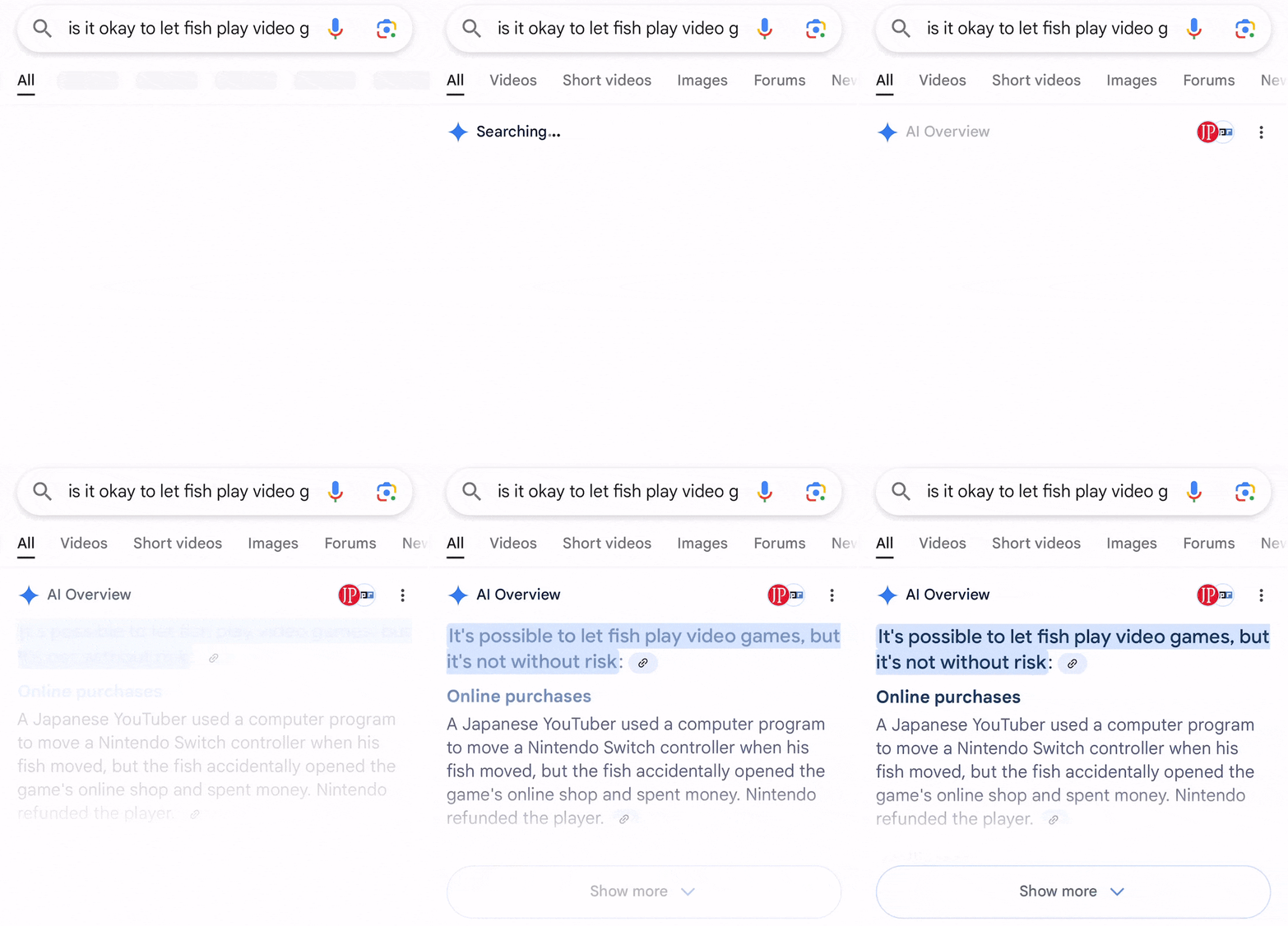
Google AI Overviews (formerly Search Generative Experience, or SGE) are AI-generated summaries that appear at the top of Google’s search results. Instead of showing ten blue links and letting you figure it out, Google synthesises information from multiple sources into a direct answer, with citations, before the user ever sees a traditional organic result.
They launched publicly in May 2024 and they’ve been expanding ever since. Semrush tracked over 10 million keywords through 2025 and found AI Overview prevalence climbed from around 6.5% of queries in January to a peak of roughly 25% in July, before settling at around 16% by the end of the year (Semrush).
The exact percentage bounces around as Google tests and retreats, and different studies measure it differently. What doesn’t bounce around is the direction of travel - and it isn’t just Google. If you want the wider picture of how AI is reshaping search beyond AIOs, I’ve compared the platforms in my post on ChatGPT Search vs Google.
How do AI Overviews actually work?
AI Overviews are built on Retrieval-Augmented Generation, or RAG. In plain English: Google’s AI doesn’t just make things up. It retrieves relevant passages from pages in its index, then synthesises those passages into a summary, with citations pointing back to the sources.
Here’s where the data has genuinely surprised people, though.
The early assumption - and it was true in 2025 - was that AIO citations came almost entirely from pages already ranking well. Ahrefs’ study in mid-2025 found 76% of AI Overview citations came from top-10 pages. By March 2026, their updated analysis of 863,000 SERPs showed that figure had dropped to just 38%, with the rest split between positions 11-100 and pages outside the top 100 altogether (Ahrefs).
I think this is the single most important shift in AI search right now, and it cuts both ways:
- Ranking in the top 10 no longer guarantees that you’ll be cited.
- And if you rank outside the top 10, you’ve still got a genuine route in.
Strong rankings still help - they’re still the most reliable single path in. But Google’s AI is increasingly willing to cite pages that answer the question well regardless of where they rank, which means content structure and clarity now carry weight they simply didn’t two years ago.
What types of queries trigger AI Overviews?
Informational queries dominate
Ahrefs analysed 146 million SERPs and found that 99.9% of keywords triggering AI Overviews carry informational intent, and that AIOs rarely appear for one-to-three-word queries but trigger often for longer queries of five words or more (Ahrefs).
Think “how does X work”, “what is X”, “best way to do X”. If your content targets knowledge-seeking searches, you should assume an AI Overview will appear for them, and start working on getting cited in it.
Not all topics are equal
In the same Ahrefs dataset, the categories with the highest AIO share were science (43.6%) and health (43%). At the other end: shopping (3.2%), real estate (5.8%), sports (14.8%) and news (15.1%).
The pattern is straightforward. Google deploys AI Overviews where it can confidently synthesise from multiple sources. Transactional, local and real-time queries have largely been spared - so far.
Google is moving down the funnel
I wouldn’t rely on that lasting, though, because the mix is shifting fast.
Semrush’s data shows that in January 2025, 91.3% of AIO-triggering queries were informational. By October, that share had fallen to 57.1%, with commercial, transactional and even navigational queries all growing - navigational alone went from under 1% to over 10% (Semrush).
I tell every audience I speak to the same thing: don’t assume AIOs are a top-of-funnel problem. The net is widening, and commercial pages are next.
Does an AI Overview hurt or help your traffic?
Honestly? It depends entirely on whether you’re cited.
The most rigorous study I’ve seen comes from Seer Interactive, who analysed 3,119 informational queries across 42 organisations - 25.1 million organic impressions between June 2024 and September 2025. When an AI Overview was present, organic CTR fell 61%, from 1.76% to 0.61%.
That’s a painful drop. But the same research found the flip side: brands cited inside the AI Overview earned 35% more organic clicks and 91% more paid clicks than brands on the same results page that weren’t cited.
So the market splits in two: uncited pages bleed clicks, and cited pages take a growing share of what’s left. That’s why getting cited sits near the top of every strategy I build now, rather than being a nice-to-have.
How to structure your content to get cited
Getting into an AI Overview isn’t about gaming anything. It’s about making your content easy for Google’s AI to extract, understand and trust. Here’s what consistently works across the sites I look at.
Lead with the answer
If your key answer is buried three scrolls deep after a lengthy introduction, it probably isn’t getting cited. Extractability matters: structure each section so the direct answer comes first, in the opening sentence or two, then expand with context underneath.
You’re writing for two readers at once here. The AI needs a clean passage it can lift, and the human who clicks through needs the context and detail underneath it.
Use clear heading structures
AI Overviews themselves are heavily formatted - lists, steps, short chunks - and content that’s already broken into digestible, well-labelled sections is far easier for a RAG system to pull from.
Use H2s and H3s framed as questions or direct topics, and make each section able to stand alone as a response to a specific question. When I audit pages that rank well but never get cited, a wall of unstructured prose is the most common culprit I find.
Add schema markup
I’ll be honest about the limits here: schema isn’t a magic ticket into AI Overviews, and anyone selling it as one is overreaching. What it does is remove ambiguity - FAQ, HowTo and Article schema help Google understand exactly what your content covers and extract the right passages accurately. Given how cheap it is to implement, there’s no reason not to.
If schema feels fiddly, I’ve written up some ways to prompt AI to create your schema markup for you.
Keep your content fresh
Refreshing content can feel tedious, but it has a real impact on AIO eligibility. If a high-performing page has sat untouched for a year or more, updating it with current data and examples is one of the fastest wins available.
Case in point: this post. The citation data changed dramatically between April and July 2026, so I rewrote it.
Build topical depth, not just individual pages
One strong post on a topic isn’t enough. AI Overviews pull from multiple sources at once, so being consistently authoritative across a topic cluster matters more than being the single best result.
This is also where you can get ahead of competitors: AI-driven search surfaces new question-shaped queries constantly, and covering them before anyone else does is essentially keyword pioneering applied to AI search. The sites winning citations in my experience are rarely the biggest - they’re the ones that covered the topic most completely, earliest.
Can you monitor your AI Overview appearances?
This is where you need to be realistic, and patient.
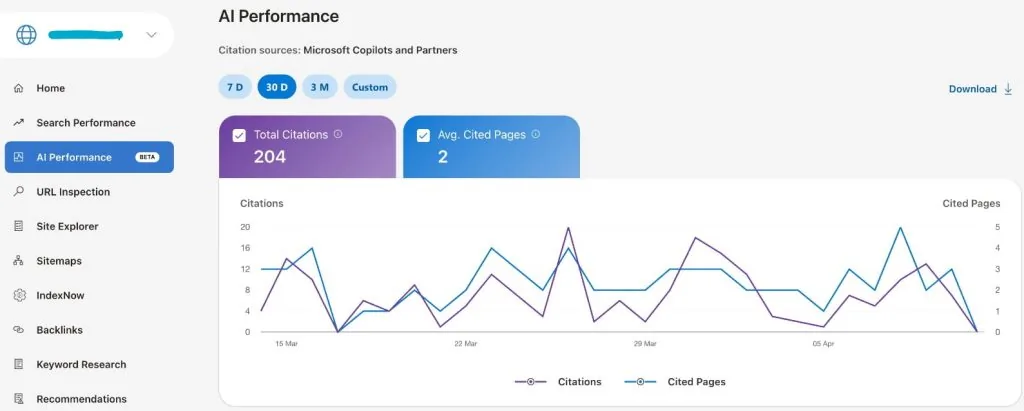
Google Search Console still doesn’t provide a dedicated view into AI Overview performance. Contrast that with Bing Webmaster Tools, which already shows you which queries triggered Copilot responses and how your content performed within them. Google has no equivalent yet, and until it does, monitoring AIO performance is an educated approximation rather than a precise science.
In the meantime, here’s what I actually use:
Third-party tools
Platforms like SE Ranking, Semrush and Ahrefs now track which of your target queries trigger AI Overviews and whether your domain is cited. Useful directionally - just take the absolute numbers with a pinch of salt.
Manual spot-checking
Test your most important queries in Incognito mode to strip out personalisation, and note when AIOs appear and who’s cited. Unsophisticated, but there’s no substitute for seeing the actual SERP.
Impression versus CTR patterns in GSC
If impressions climb significantly whilst CTR stays flat or drops, there’s a reasonable chance an AI Overview is satisfying users before they click. Cross-reference those queries against your third-party tracking and the picture usually becomes clear.
Google will eventually have to give publishers proper visibility into AI results, the same way it eventually did with Search Console for organic search. Until then, combine the three methods above and treat the numbers as directional rather than exact.
Final thoughts
AI Overviews aren’t going away - they’re expanding into more query types, more countries and more industries every month, and the link between traditional rankings and AI citations is loosening as they do.
The sites that win here make AIO visibility a core part of their SEO work: structuring content for extraction, building genuine topical depth, and measuring with the imperfect tools we’ve got. That’s a real opportunity for anyone willing to move before their competitors do, and right now most of them haven’t.
If you’d like a second pair of eyes on your AI Overview strategy, speak to me - it’s most of what my client work looks like these days.