Common SEO Mistakes to Avoid
 Itamar Blauer6 min read
SEO mistakes are surprisingly consistent across industries and experience levels. Even experienced practitioners fall into the same traps.
Here are the most common SEO mistakes I see, and what to do instead.
1. Focusing too much on rankings (and not enough on traffic)
I’ll start off by mentioning that search engine rankings are vanity metrics.
Reason being, they don’t directly impact the bottom line.
Sure, having 100s of #1 rankings might sound awesome, but if the reality is that nobody really searches for those queries or clicks through to your website, then what’s the point?

Ranking alone won’t guarantee results, rather, the focus should be on the traffic that you can generate from your rankings (no matter where you rank on the SERP).
Take a look at your traffic data from Google Analytics and Google Search Console to see which pages are driving the most traffic.
Doing this is much better than checking your rankings (which may fluctuate very frequently).
2. Not internally linking
Internal linking is absolutely fundamental to help search engines discover content on your website.
They’re also great for sending down the funnel, so they can access the money pages you want them to.
Without a good internal linking structure, you may be limiting the amount of SEO power being distributed across your domain.
The best way to identify internal linking opportunities is to perform a site: search on Google with a keyword to see if you’ve talked about it in multiple pages.
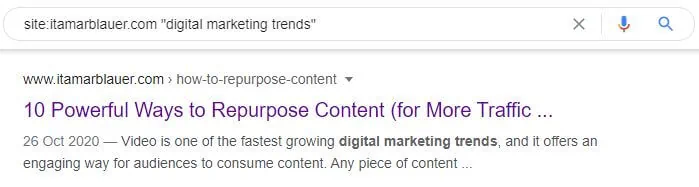
Then, you can internally link these pages as some of the content will be related.
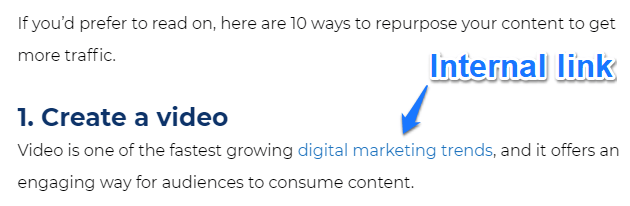
In this example, I found other pages on my website where I talked about digital marketing trends, so I added an internal link to that article.
3. Changing URL slugs instead of page titles
If you’re going to make updates to a page, don’t change the URL.
Changing the URL of a page essentially means that you will have to redirect all occasions of the previous URL to the updated one.
This can take a long time, and is especially tedious if you have backlinks pointing to the old URL.
If you don’t enforce redirects, then those links to the old URL will end up being 404s, which are bad.

When updating a post, it’s fine to update the content itself (and even the title/H1).
But whatever you do… don’t change the URL slug.
4. Not considering user intent
Users are at the heart of content, as they are the ones who want to seek and consume it.
When you create content without considering user intent, you might miss out on what that user actually wants.
For instance, when people search for ‘Apple’, the main intent is to look for Apple products (and not the fruit, sadly).
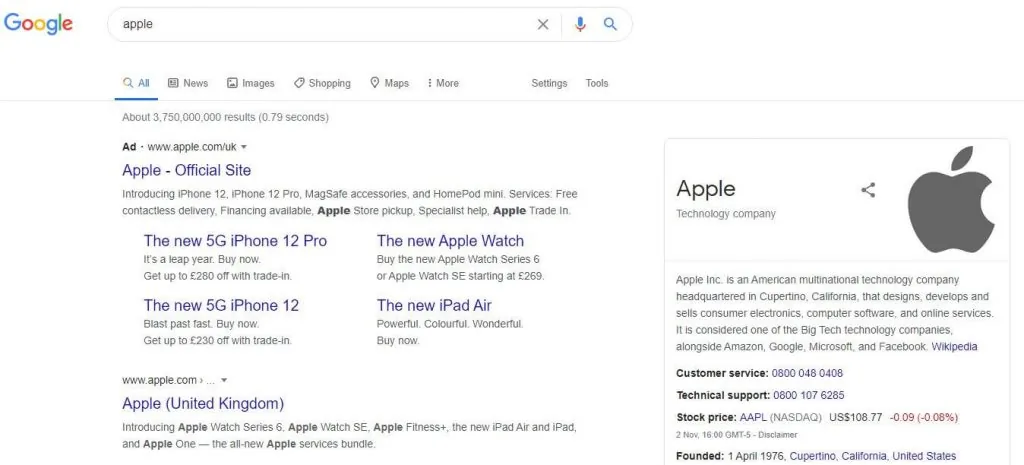
A great way to determine the user intent is to manually perform a search for a keyword you’re targeting.
The results that show up are a good indication of the intent that users predominantly have when they search for that keyword.
Use this guidance to shape your content so that you are better matching for your user’s intent.
5. Inconsistent link building
Consistency is key, especially when it comes to link building.
Building loads of backlinks one month and then not generating any in the next few months will give negative signs to search engines.
They might think that your content isn’t good enough anymore, or that it’s outdated.
Your link building activities should run over the course of many months, where you’re actively acquiring backlinks in a natural way that reflects how your content is better suited to match a query on an ongoing basis.
A good way to think about this is going to the gym.
You might get some gains over the first couple of months, but as soon as you stop training over the following few months, your gains will disappear.
And in this example, gains are rankings.
Building links consistently is also related to having awesome content that adds value to people, and using the Teammate Technique can help you achieve this effectively.
6. Not checking the SERP
The problem that arises when some people use SEO tools is that they rely on them too much, without performing manual checks.
The SERP should always be your first port of call, as you can see what content Google is rewarding for a particular keyword.
I’m not going to say that SEO tools are bad and you shouldn’t use them, but don’t solely rely on SEO tools without manually checking the SERP.
Linking back to what was mentioned earlier about user intent - the best way to know this is by looking at the SERP.
So please, don’t neglect the SERP!
7. Publishing AI content without adding genuine value
AI writing tools have made it possible to produce content at scale. The problem is that most AI-generated content looks and reads like most other AI-generated content - generic, surface-level, and indistinguishable from a hundred other pages covering the same topic.
Google has been explicit about this. The question it’s asking isn’t “was this written by a human or AI?” - it’s “does this content provide genuine value and demonstrate real expertise?”
If you’re using AI to write content, that’s fine. But you need to be adding your own experience, original insights, specific examples, and a clear point of view on top of the AI output. Without that layer, you’re producing content that’s unlikely to rank and unlikely to convert.
8. Ignoring your Google Search Console data
Google Search Console is free, directly from Google, and tells you exactly which queries are driving impressions and clicks to your site. It also shows you which pages have technical issues that Google has flagged.
Despite this, a huge number of website owners either don’t have it set up or check it infrequently.
Specific things to look at in GSC regularly: your top queries by impressions vs clicks (high impression, low CTR pages are quick-win optimisation opportunities), any coverage errors in the Index report, and Core Web Vitals issues under the Experience tab.
If you’re not checking GSC at least monthly, you’re ignoring data that’s sitting right there for free.
9. Optimising only for rankings and ignoring AI visibility
This builds on mistake number one. Rankings still matter; but they’re no longer the only measure of organic visibility.
Google’s AI Overviews now appear above organic results for a huge range of queries. If your content is cited in an AI Overview, you can receive visibility and traffic even when you’re not ranking in position one. If you’re in position one but the AI Overview answers the query before a user sees your listing, your traffic may be lower than your ranking suggests.
A mindset shift is needed, where instead of just asking “what position do I rank for this keyword?”, also ask “is my content appearing in AI Overviews for this topic?” and “is my content structured in a way that AI tools can easily extract and cite?”
There are tools out there that track AI Overview appearances alongside traditional rankings (although accuracy and methodology may vary). Set them up so you have full visibility on both.
Summing it up
SEO is and will continue to develop over time, but it’s important to avoid these mistakes that can cost your website its rankings, traffic, and potentially, leads.
If you want someone to guide your SEO strategy so that you won’t make these (and other) SEO mistakes, contact your SEO consultant London.