How to Repurpose Content (for More Traffic)
 Itamar Blauer8 min read
Great content should be rewarded, right?
It’s extremely common to see quality content that doesn’t generate the amount of traffic that it deserves.
In most cases, this is the result of a poor content repurposing strategy.
What is content repurposing?
Content repurposing is the re-distribution of content in different formats across a wide range of platforms that your audiences are active on.
The strategy is useful for content to stay relevant and potentially go viral within various online communities, maximising its traffic potential.
How to repurpose content
First, you must have content published that will be easy to display in other forms, such as audio and video.
There are plenty of ways to repurpose content, and I practise what I preach here - if you’d like to watch this very post in video format, you can do so below.
If you’d prefer to read on, here are 11 ways to repurpose your content to get more traffic.
1. Create a video
Video is one of the fastest growing digital marketing trends, and it offers an engaging way for audiences to consume content.
Any piece of content you’ve ever released can be turned into a video, and it offers plenty of opportunities to get more traffic on popular video hosting platforms such as YouTube.
Of course, there are a lot of things to consider when creating videos, so it’s worth reading about how to create an effective video marketing strategy before getting started.

2. Release a podcast
Let’s say you’ve just recorded a video.
Why not download the audio of the video and release a podcast episode about it?
Alternatively, if you are creating a video, you can just render the audio to have an .MP3 file ready for you to use for a podcast.
If you want to record a podcast episode from scratch, you can use free tools such as Audacity to record your audio.
Podcasting is a channel I’ve invested in myself with SEO Unplugged, and the crossover with my other content is constant - topics I’ve written about become episodes, and episode conversations spark new posts.

3. Design an infographic
Got an epic blog post such as this one?
Why not turn some of the content into an eye-catching infographic that you can share on the web?
There are plenty of freemium tools you can use, such as Canva or Visme, or paid tools like Photoshop.
Infographics are great because they draw attention and are easy to digest.
Have a look at the infographic for this blog post, for instance.
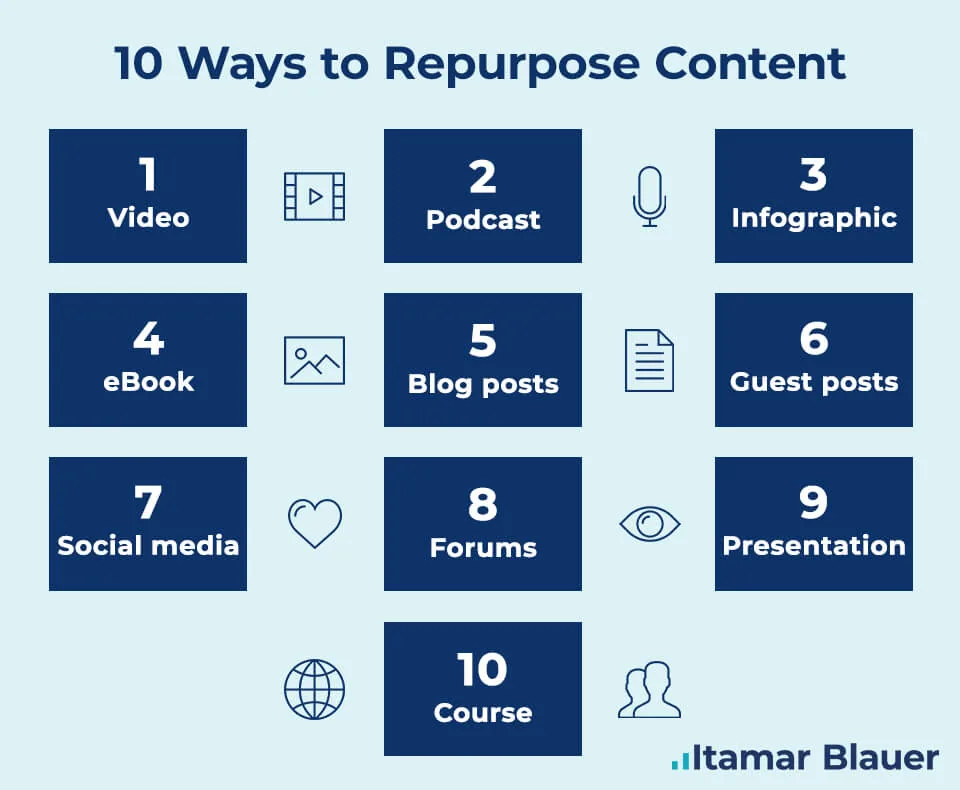
(A quick note on the title - the infographic covers the original ten methods from when this post was first published. The eleventh, further down, came along later.)
It’s usually best to design an infographic when you have content that includes a list, roundup, or research findings.
4. Write an eBook
eBooks remain a strong format for long-form authority content.
You can jot your knowledge down on a Word document and start crafting a compelling eBook.
The perks of writing eBooks is that you can choose a great platform to display it on, such as Amazon Kindle, and a book carries a level of credibility that individual blog posts rarely match.
I’ve done this myself - I took everything I’d learned about keyword research and packaged it into Keywords for SEO. It gives people something concrete to point to when they’re deciding whether you actually know your subject.
Plus, being an author sounds pretty neat.

5. Publish new blog posts
When looking at your current website content, there are often ways to branch out and come up with new content ideas.
The best way to do this is to find new angles to take that you haven’t yet explored in your current blog posts.
Then, draw upon your old content and internally link to it, whilst making the bulk of the new blog post all about the new angle that you’re exploring.
This strategy works really well if you’re covering a trending topic, or if you haven’t published a post in a while and want your audience to know that you still exist!
6. Feature in guest posts
Guest posts are still very valuable in terms of increasing your digital footprint and gaining brand authority.
Similarly to step 5, you can write about a new angle of a current blog post you have - but on a different website.
The best part about this is that you can strategically link to the post on your website, whilst providing new ideas, concepts, or flavour to the guest post you’re writing.
7. Share on social media
What’s the point of just keeping content hostage on your website?
Share it across social media using relevant hashtags to increase your impressions.
You can also share videos on social media strategically to maximise your traffic.
First render a short clip of the entire video and upload those natively on social media.
Then, provide a link to the full video, whether it is on your website or a video hosting platform like YouTube, in the post caption.
This will help generate more interest in your video content as you’ve essentially provided a teaser to the full thing.
Even if you’re just sharing a blog post, use the post caption to entice your audience to click through to it and generate more traffic.

8. Share on forums
Don’t forget about forums.
You can often find very niche communities on platforms such as Reddit, or use your content to answer questions posted on Quora.
When repurposing content on forums, it’s important to prioritise giving value, as opposed to just sharing a link to your content.
Just like writing good social media post captions, it’s important to set the scene and entice users to click through to your content.

9. Make a presentation
You can use content that you already have to make a stellar presentation, which you can use when speaking at events or conferences.
It may be worth timing yourself when the presentation is made, so you have an idea of whether you need more content or not.
Presentations should always be updated too, so don’t forget to add some external content in the mix such as recent statistics/other relevant data.

10. Sell a course
Why not monetise your current content to generate more traffic and more money?
If you have a bank of content that you think someone would pay for, consider signing up to platforms like Podia or Thinkific.
It’s a great way to earn some passive income from the content you already have published.
11. Use AI to scale your repurposing
This one wasn’t a practical option when I first wrote this post back in 2020, but it’s now one of the most powerful ways to repurpose content.
AI tools like ChatGPT and Claude can take a single piece of content and reformulate it for multiple formats and platforms in minutes. Here’s what that looks like in practice:
Blog post → LinkedIn carousel: Paste your post into ChatGPT and prompt it to extract the five key points and rewrite each one as a slide for a LinkedIn carousel, with a hook for slide one and a CTA for the final slide.
Blog post → Short-form video scripts: Ask AI to pull out the three most quotable or counterintuitive insights from your post and rewrite each as a 45-second TikTok or YouTube Shorts script, with a hook in the first three seconds.
Podcast transcript → SEO article: If you record a podcast or video, run the transcript through an AI tool and ask it to restructure the content as a blog post with proper headings, a clear introduction, and a summary. This is one of the fastest ways to build topical content.
Long-form content → Email newsletter: Ask AI to summarise your latest blog post into a 150-word email-friendly version with a “read the full post” CTA.
The key with AI repurposing is that it accelerates the production work - but you still need to review the output, add your own voice, and make sure it’s accurate before publishing. Treat whatever it gives you as a first draft.
Conclusion
Content repurposing has always been one of the highest-ROI activities in digital marketing. It’s a big part of how I run my own content - the same ideas end up as blog posts, YouTube videos, and podcast episodes, and each format reaches people the others don’t.
What’s changed is the speed at which you can do it. AI tools have stripped out most of the production friction that used to make repurposing feel like a chore, so if you’ve got good content sitting idle, you’re missing out on traffic you’ve already earned.
Start with one piece of content you’re proud of, pick two or three formats from this list, and build from there.
If you need help putting together a content strategy that makes the most of what you already have, get in touch.