
Digital PR and SEO: What You Need to Know
 Itamar Blauer6 min read
Digital PR and SEO are the current buzzwords within the digital marketing sphere, and these terms are at the forefront of many business’ minds when trying to increase their online visibility.
In this blog post, we’ll look into how digital PR and SEO work hand-in-hand to increase both organic search performance and brand awareness.
What is digital PR?
To put it simply, digital PR is the means of obtaining editorial backlinks from reputable, authoritative websites using PR techniques.
To obtain these backlinks, your website needs to have link-worthy content that stands out and is attractive for journalists and the press to want to cover (and link to). There are many link building strategies that come under digital PR, but the crux of this lies within building relationships and having content that stands out from the noise.
Digital PR also utilises various digital marketing disciplines such as content marketing and social media marketing, leading to a holistic digital brand-strengthening strategy.

Importance of digital PR
With an abundance of content online and businesses offering similar products/services, it’s more important than ever to stand out and increase your brand positioning. This positioning can be from an organic search perspective or from a brand awareness perspective. Essentially, your online brand management needs to be stronger than your competitors - and digital PR can achieve this.
The increased use of social media has signalled how crucial it is to have a voice online. Digital PR can get you a voice that speaks louder than the rest of your competitors.
When using digital PR as part of your overall digital marketing strategy, it can leverage your ability to win over prospective customers through highly perceived awareness in some of the world’s largest news outlets, social media profiles and websites.
The way digital PR ties in with SEO is in regards to the links that you can acquire from it - so let’s dig deeper into the link building aspect of digital PR.
What is digital PR link building?
Digital PR link building isn’t too dissimilar from other link building methods, but creativity is key to ensure that you get your content out to the masses.
The reason why digital PR link building differs from traditional link building is that digital PR link building strives for greater reach (and can therefore be more time consuming and expensive), whereas traditional link building is generally scaled down to a more specific niche/purpose of just getting a link (without the added branding benefits of digital PR).
How do I get a digital PR link?
First, it’s important to figure out how best to reach journalists, since they are the people that will take your stories and push them out to a mass audience. There are lots of ways to do this, but here are the main ways you can get in touch with journalists:
- Responding to journalist requests on platforms like Qwoted, Featured, and ResponseSource (HARO, the old favourite, shut down in 2024)
- Monitoring the #JournoRequest hashtag on X, where many journalists still post source requests
- Speaking at industry events
- Building direct relationships with the journalists who cover your niche
Once you’re in the sights of journalists, you can start working on your PR link building. Some examples of digital PR link building strategies include:
- Newsjacking
- Research studies that include fresh and unique data
- Combining various statistic pieces together into one, digestible piece of content
- Simply making creative content that people haven’t seen before

Digital PR outreach tips
The biggest hurdle people have when approaching journalists is their outreach strategy.
You need to remember that journalists are busy people, and if you can’t get to the point and convince them why you’re worth their time, they’ll most likely ignore you.
Some common mistakes that people have when outreaching to journalists is that they’ll either be waffling too much or not emphasising the uniqueness of their content.
People also forget that in instances such as industry roundups, the authors of these posts will most likely only write about that particular roundup once and will not be updating it with new content. I’ve personally heard from PR people that this is way too common and the focus should be on figuring out what areas that journalist usually covers as opposed to trying to get them to add your insights to an existing post (which they cannot do).
How does digital PR benefit your SEO?
There is an increasing convergence between digital PR and SEO, and the main reason why SEOs care about digital PR is the strength of the backlinks that are often associated with it.
A successful digital PR campaign can secure lots of valuable backlinks to your website from trusted industry/national sources, and this can greatly improve how search engines perceive your brand from an experience, expertise, authoritativeness, and trustworthiness (E-E-A-T) standpoint.
Google is smart enough to detect strong E-E-A-T signals and digital PR is arguably one of the better strategies to enhance them.
Increased brand awareness via digital PR can also provide some great social signals, and whilst those might not be a direct ranking factor, they’re still important for your brand and to get more conversions on your website.
You can also measure the impact of digital PR towards your overall SEO goals, such as through assessing the earned backlinks for their quality (referring domains, follow vs nofollow ratio, anchor text) or checking your website’s engagement/organic traffic figures.
One last thing to note is that digital PR can end up being much more efficient at generating links than any other link building strategy because a successful campaign can reel in links at scale - and only from one campaign. This means that you won’t compromise on the quality of links earned for obtaining more backlinks from a single digital PR campaign.
The future of digital PR and SEO
We know that SEO isn’t going away anytime soon, and frankly, neither is digital PR.
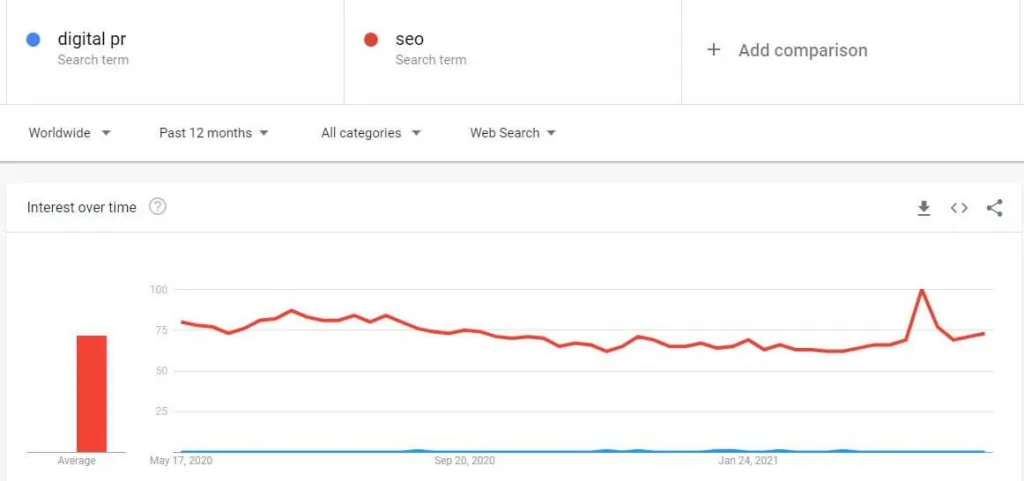
The Google Trends chart above is from when I originally wrote this post in 2021 - at the time, I predicted that the term was only going to increase in popularity over the next few years. That prediction has aged well: search interest kept climbing, and digital PR is now a standard part of most serious SEO strategies.
AI search has made it even more important. LLMs like ChatGPT and Perplexity lean on coverage from trusted publications when deciding which brands to mention in their answers, which means the links and mentions that digital PR earns now work twice - once for your Google rankings (they’re core E-E-A-T signals), and once for your visibility in AI answers. It’s a big part of why I offer digital PR services to clients today.
The scalability of SEO remains the same - more content, more backlinks. Digital PR can fuel both of these aspects, and the addition of earned coverage from major reputable websites will do a world of good for you in the long-term (as you can earn links that are much harder to obtain).
As always, digital PR is going to be used hand-in-hand with SEO to increase a website’s search engine rankings, so if you’re looking for tailored advice on how to rank higher on Google, contact your friendly neighbourhood SEO consultant 🙂